-
Title
-
The Story of the Chinese Stone Lion - Panel 2
-
Transcript
-
Gift to Union College
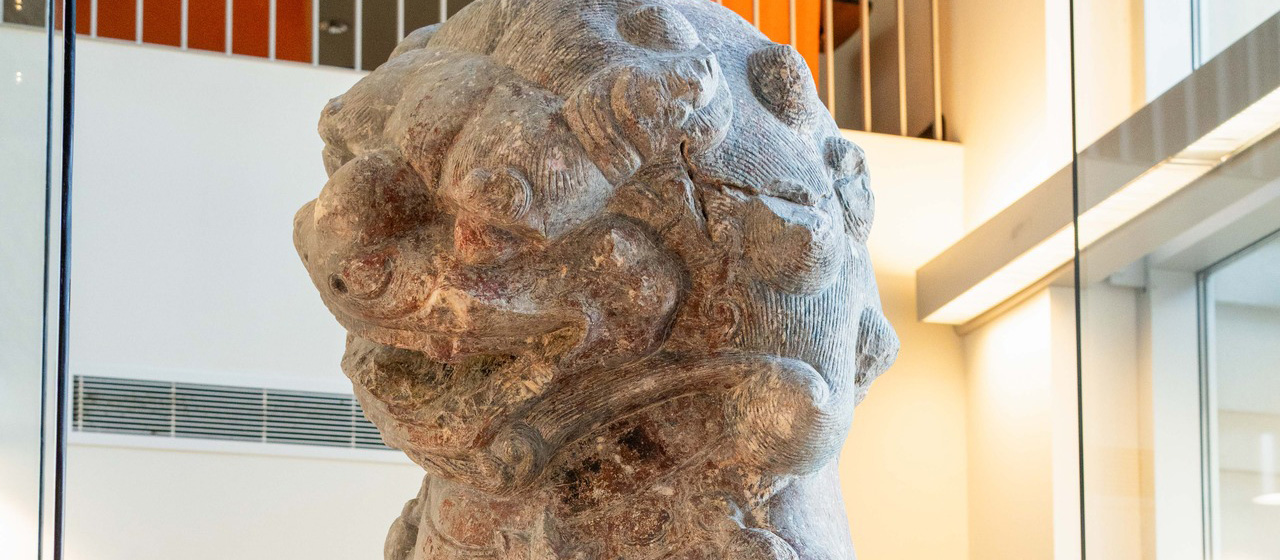
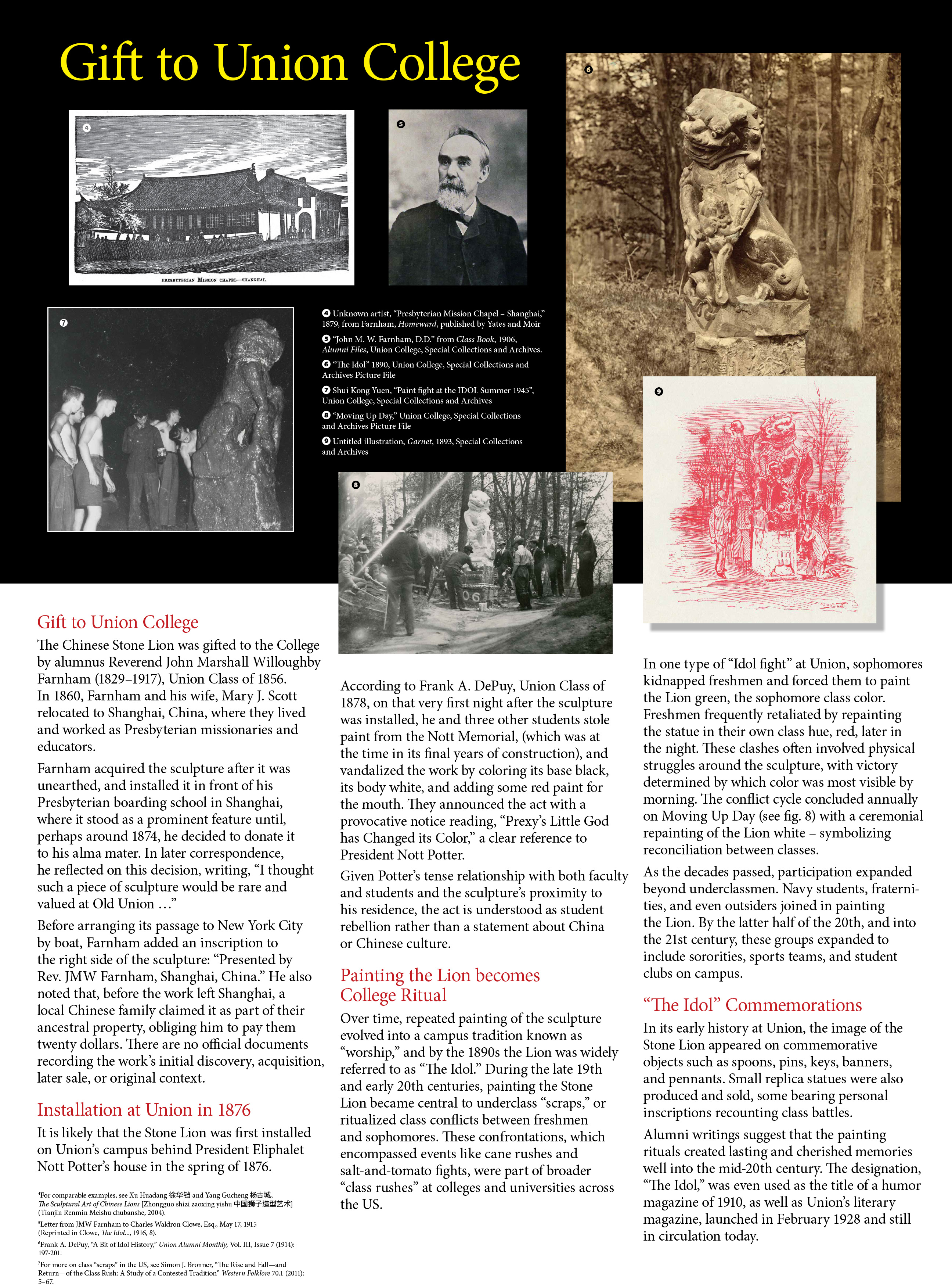
The Chinese Stone Lion was gifted to the College by alumnus Reverend John Marshall Willoughby Farnham (1829–1917), Union Class of 1856. In 1860, Farnham and his wife, Mary J. Scott relocated to Shanghai, China, where they lived and worked as Presbyterian missionaries and educators.
Farnham acquired the sculpture after it was unearthed, and installed it in front of his Presbyterian boarding school, where it stood as a prominent feature until, perhaps around 1874, he decided to donate it to his alma mater. In later correspondence, he reflected on this decision, writing, “I thought such a piece of sculpture would be rare and valued at Old Union …”
Before arranging its passage to New York City by boat, Farnham added an inscription to the right side of the sculpture: “Presented by Rev. JMW Farnham, Shanghai, China.” He also noted that, before the work left Shanghai, a local Chinese family claimed it as part of their ancestral property, obliging him to pay them twenty dollars. There are no official documents recording the work’s initial discovery, acquisition, later sale, or original context.
Installation at Union in 1876
It is likely that the Stone Lion was first installed on Union’s campus behind President Eliphalet Nott Potter’s house in the spring of 1876.
According to Frank A. DePuy, class of 1878, on that very first night after the sculpture was installed, he and three other students stole paint from the Nott Memorial, which was at the time in its final years of construction, and vandalized the work by coloring its base black, its body white, and adding some red paint for the mouth. They announced the act with a provocative notice on the chapel door reading, “Prexy’s Little God has Changed its Color,” a clear reference to President Nott Potter.
Given Potter’s tense relationship with both faculty and students and the sculpture’s proximity to his residence, the act is understood as student rebellion rather than a statement about China or Chinese culture.
Painting the Lion becomes College Ritual
Over time, repeated painting of the sculpture evolved into a campus tradition known as “worship,” and by the 1890s the lion was widely referred to as “The Idol.” During the late 19th and early 20th centuries, painting the Stone Lion became central to underclass “scraps,” or ritualized class conflicts between freshmen and sophomores.These confrontations, which encompassed events like cane rushes and salt-and-tomato fights, were part of a broader “class rushes” at colleges and universities across the US.
In one type of “Idol fight” at Union, sophomores kidnapped freshmen and forced them to paint the lion green, the sophomore class color. Freshmen frequently retaliated by repainting the statue in their own class hue, red, later in the night. These clashes often involved physical struggles around the sculpture, with victory determined by which color was most visible by morning. The conflict cycle concluded annually with a ceremonial repainting of the lion white - symbolizing reconciliation between classes.
As the decades passed, participation expanded beyond underclassmen. Navy students, fraternities, and even outsiders joined in painting the Chinese Stone Lion. By the latter half of the 20th and into the 21st century, these groups expanded to include sororities, sports teams, and student clubs on campus.
“The Idol” Commemorations
In its early history at Union, the image of the Stone Lion appeared on commemorative objects such as spoons, pins, keys, banners, and pennants. Small replica statues of the Stone Lion were also produced and sold, some bearing personal inscriptions recounting class battles.
Alumni writings suggest that the painting rituals created lasting and cherished memories, well into the mid-20th century. The designation, “The Idol,” was even used as the title of a humor magazine of 1910, as well as Union’s literary magazine, launched in February 1928 and still in circulation today.