Items
-

-
-
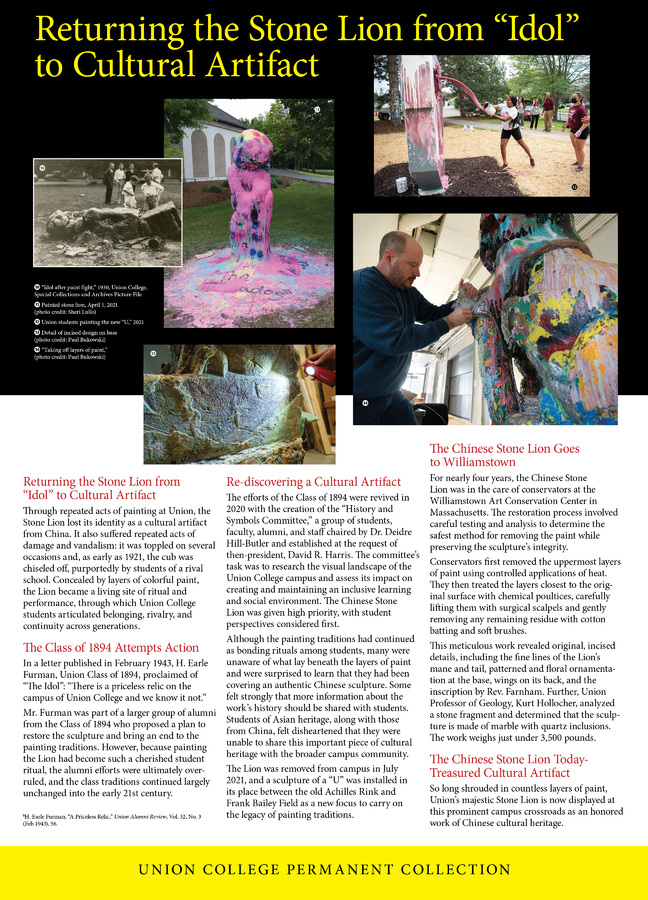 The Story of the Chinese Stone Lion - Panel 3Returning the Stone Lion from “Idol” to Cultural Artifact Through repeated acts of painting at Union, the Stone Lion lost its identity as a cultural artifact from China. It also suffered repeated acts of damage and vandalism: it was toppled on several occasions and, as early as 1921, the cub was chiseled off, purportedly by students of a rival school. Concealed by layers of colorful paint, the Stone Lion became a living site of ritual and performance, through which Union College students articulated belonging, rivalry, and continuity across generations. The Class of 1894 Attempts Action In a letter published in February 1943, H. Earle Furman, Union Class of 1894, proclaimed of “The Idol”: “There is a priceless relic on the campus of Union College and we know it not.” Mr. Furman was part of a larger group of alumni from the Class of 1894 who proposed a plan to restore the sculpture and bring an end to the painting traditions. However, because painting the lion had become such a cherished student ritual, the alumni efforts were ultimately overruled, and the class traditions continued largely unchanged into the early 21st century. Re-discovering the Chinese Stone Lion as a Cultural Artifact The efforts of the Class of 1894 were revived in 2020 with the creation of the “History and Symbols Committee,” a group of students, faculty, alumni, and staff chaired by Dr. Deidre Hill-Butler and established at the request of then-president, David R. Harris. The committee’s task was to research the visual landscape of the Union College campus and assess its impact on creating and maintaining an inclusive learning and social environment. The Chinese Stone Lion was given high priority, with student perspectives considered first. Although the painting traditions had continued as bonding rituals among students, many were unaware of what lay beneath the layers of paint and were surprised to learn they had been covering an authentic Chinese sculpture. Some felt strongly that more information about the work’s history should be shared with students. Students of Asian heritage, along with those from China, felt disheartened that they were unable to share this important piece of cultural heritage with the broader campus community. The Stone Lion was removed from campus in July 2021, and a sculpture of a “U” was installed in its place between the old Achilles Rink and Frank Bailey Fieldas a new focus to carry on the legacy of painting traditions. The Chinese Lion goes to Williamstown For nearly four years, the Chinese Stone Lion was in the care of conservators at the Williamstown Art Conservation Center in Massachusetts. The process involved careful testing and analysis to determine the safest method for removing the paint while preserving the sculpture’s integrity. Conservators first removed the uppermost layers of paint using controlled applications of heat. They then treated the layers closest to the original surface with chemical poultices, carefully lifting them with surgical scalpels and gently removing any remaining residue with cotton batting and soft brushes. This meticulous work revealed original incised details, including the fine lines of the lion’s mane and tail, patterned and floral ornamentation at the base, wings on its back, and the inscription by Rev. Farnham. Further, Union Professor of Geology, Kurt Hollocher, analyzed a stone fragment and determined that the sculpture is made of marble with quartz inclusions. The work weighs just under 3,500 pounds. The Chinese Stone Lion Today- treasured cultural artifact So long shrouded in countless layers of paint, Union’s majestic Stone Lion is now displayed at this prominent campus crossroads as an honored work of Chinese cultural heritage.
-
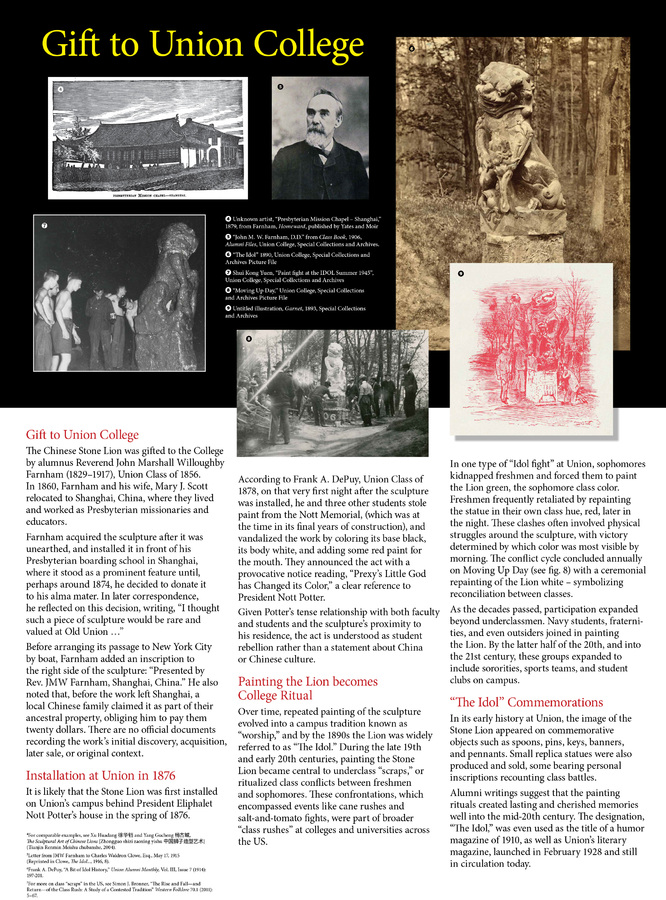 The Story of the Chinese Stone Lion - Panel 2Gift to Union College The Chinese Stone Lion was gifted to the College by alumnus Reverend John Marshall Willoughby Farnham (1829–1917), Union Class of 1856. In 1860, Farnham and his wife, Mary J. Scott relocated to Shanghai, China, where they lived and worked as Presbyterian missionaries and educators. Farnham acquired the sculpture after it was unearthed, and installed it in front of his Presbyterian boarding school, where it stood as a prominent feature until, perhaps around 1874, he decided to donate it to his alma mater. In later correspondence, he reflected on this decision, writing, “I thought such a piece of sculpture would be rare and valued at Old Union …” Before arranging its passage to New York City by boat, Farnham added an inscription to the right side of the sculpture: “Presented by Rev. JMW Farnham, Shanghai, China.” He also noted that, before the work left Shanghai, a local Chinese family claimed it as part of their ancestral property, obliging him to pay them twenty dollars. There are no official documents recording the work’s initial discovery, acquisition, later sale, or original context. Installation at Union in 1876 It is likely that the Stone Lion was first installed on Union’s campus behind President Eliphalet Nott Potter’s house in the spring of 1876. According to Frank A. DePuy, class of 1878, on that very first night after the sculpture was installed, he and three other students stole paint from the Nott Memorial, which was at the time in its final years of construction, and vandalized the work by coloring its base black, its body white, and adding some red paint for the mouth. They announced the act with a provocative notice on the chapel door reading, “Prexy’s Little God has Changed its Color,” a clear reference to President Nott Potter. Given Potter’s tense relationship with both faculty and students and the sculpture’s proximity to his residence, the act is understood as student rebellion rather than a statement about China or Chinese culture. Painting the Lion becomes College Ritual Over time, repeated painting of the sculpture evolved into a campus tradition known as “worship,” and by the 1890s the lion was widely referred to as “The Idol.” During the late 19th and early 20th centuries, painting the Stone Lion became central to underclass “scraps,” or ritualized class conflicts between freshmen and sophomores.These confrontations, which encompassed events like cane rushes and salt-and-tomato fights, were part of a broader “class rushes” at colleges and universities across the US. In one type of “Idol fight” at Union, sophomores kidnapped freshmen and forced them to paint the lion green, the sophomore class color. Freshmen frequently retaliated by repainting the statue in their own class hue, red, later in the night. These clashes often involved physical struggles around the sculpture, with victory determined by which color was most visible by morning. The conflict cycle concluded annually with a ceremonial repainting of the lion white - symbolizing reconciliation between classes. As the decades passed, participation expanded beyond underclassmen. Navy students, fraternities, and even outsiders joined in painting the Chinese Stone Lion. By the latter half of the 20th and into the 21st century, these groups expanded to include sororities, sports teams, and student clubs on campus. “The Idol” Commemorations In its early history at Union, the image of the Stone Lion appeared on commemorative objects such as spoons, pins, keys, banners, and pennants. Small replica statues of the Stone Lion were also produced and sold, some bearing personal inscriptions recounting class battles. Alumni writings suggest that the painting rituals created lasting and cherished memories, well into the mid-20th century. The designation, “The Idol,” was even used as the title of a humor magazine of 1910, as well as Union’s literary magazine, launched in February 1928 and still in circulation today.
-
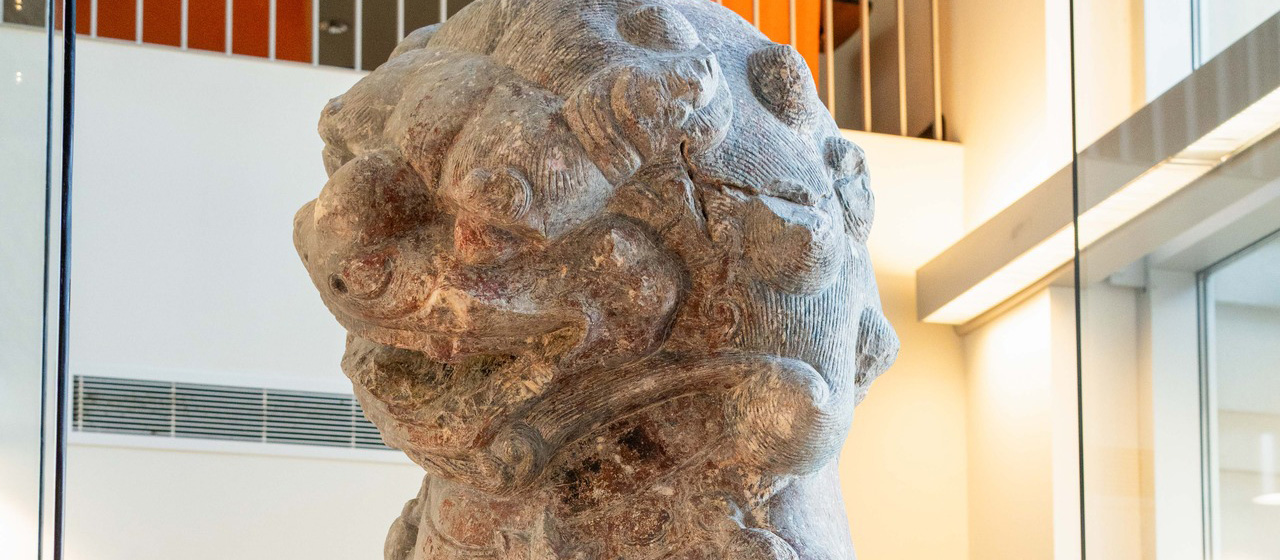
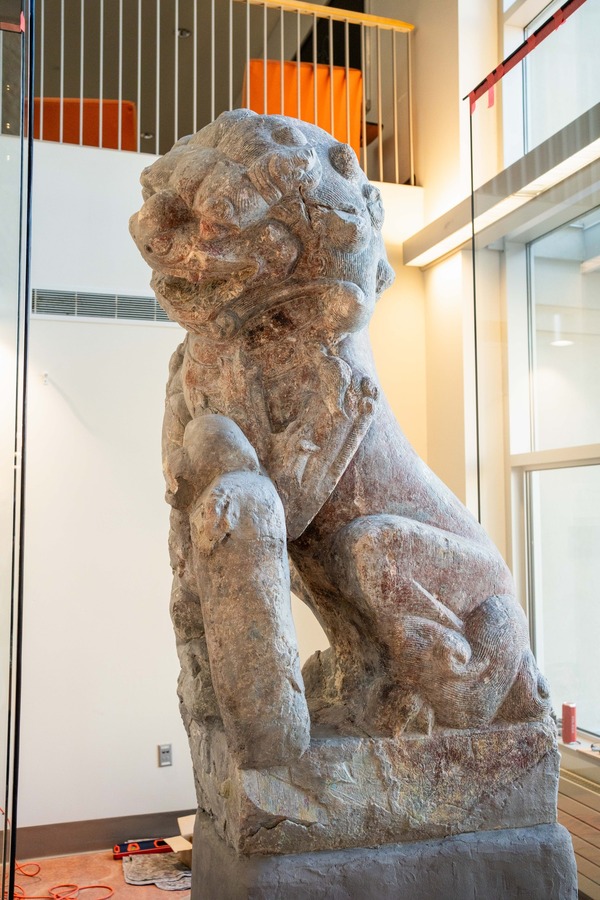
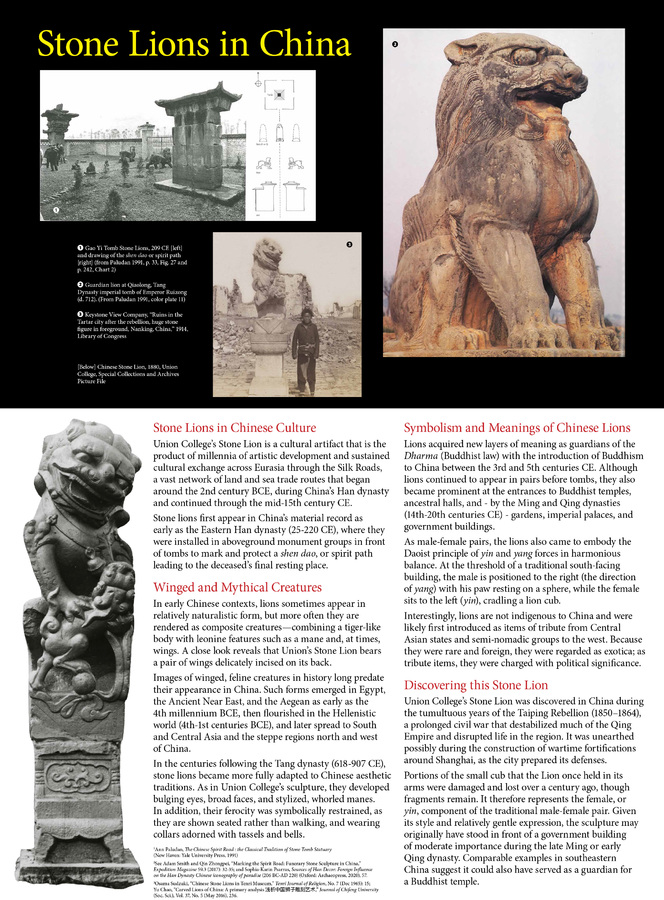 The Story of the Chinese Stone Lion Intro PanelStone Lions in Chinese Culture Union College’s Stone Lion is a cultural artifact that is the product of millennia of artistic development and sustained cultural exchange across Eurasia through the Silk Roads, a vast network of land and sea trade routes that began around the 2nd century BCE, during China’s Han Dynasty and continued through the mid-15th century CE. Stone lions first appear in China’s material record as early as the Eastern Han dynasty (25-220 CE), where they were installed in aboveground monument groups in front of tombs to mark and protect a shen dao, or spirit path leading to the deceased’s final resting place. Winged and Mythical Creatures In early Chinese contexts, lions sometimes appear in relatively naturalistic form, but more often they are rendered as composite creatures—combining a tiger-like body with leonine features such as a mane and, at times, wings. A close look reveals that Union’s lion bears a pair of wings delicately incised on its back. Images of winged feline creatures long predate their appearance in China. Such forms emerged in Egypt, the ancient Near East, and the Aegean as early as the fourth millennium BCE, flourished in the Hellenistic world, and later spread to South and Central Asia and the steppe regions north and west of China. In the centuries following the Tang Dynasty (618-907 CE), stone lions became more fully adapted to Chinese aesthetic traditions. As in Union College’s sculpture, they developed bulging eyes, broad faces, and stylized whorled manes. In addition, their ferocity was symbolically restrained, as they are shown seated rather than walking, and wearing collars adorned with tassels and bells. Symbolism and Meanings of Chinese Stone Lions Lions acquired new layers of meaning as guardians of the Dharma (Buddhist law) with the introduction of Buddhism to China between the 3rd and 5th centuries CE. Although lions continued to appear in pairs before tombs, they also became prominent guardians at the entrances to Buddhist temples, ancestral halls, and—by the Ming dynasty and Qing dynasties (14th-20th c CE)—gardens, imperial palaces, and government buildings. As male-female pairs, the lions also came to embody the Daoist principle of yin and yang. At the threshold of a traditional south-facing building, the male is positioned to the right (the direction of yang) with his paw resting on a sphere, while the female sits to the left (yin), cradling a lion cub. Interestingly, lions are not indigenous to China and were likely first introduced as items of tribute from Central Asian states and semi-nomadic groups to the west. Because they were rare and foreign, they were regarded as exotica; as tribute items, they were charged with political significance. Discovering this Stone Lion Union College’s Stone Lion was discovered during the tumultuous years of the Taiping Rebellion (1850–1864), a prolonged civil war that destabilized much of the Qing Empire and disrupted life in the region. It was unearthed possibly during the construction of wartime fortifications around Shanghai as the city prepared its defenses. Portions of the small cub Union’s Stone Lion once protected were damaged and lost over a century ago, though fragments remain. It therefore represents the female, or yin, component of the traditional male-female pair. Given its style and relatively gentle expression, the sculpture may originally have stood in front of a government building of moderate importance during the late Ming or early Qing dynasty. Comparable examples in southeastern China suggest it could also have served as a guardian for a Buddhist temple.