-
Title
-
The Story of the Chinese Stone Lion Intro Panel
-
Transcript
-
Stone Lions in Chinese Culture
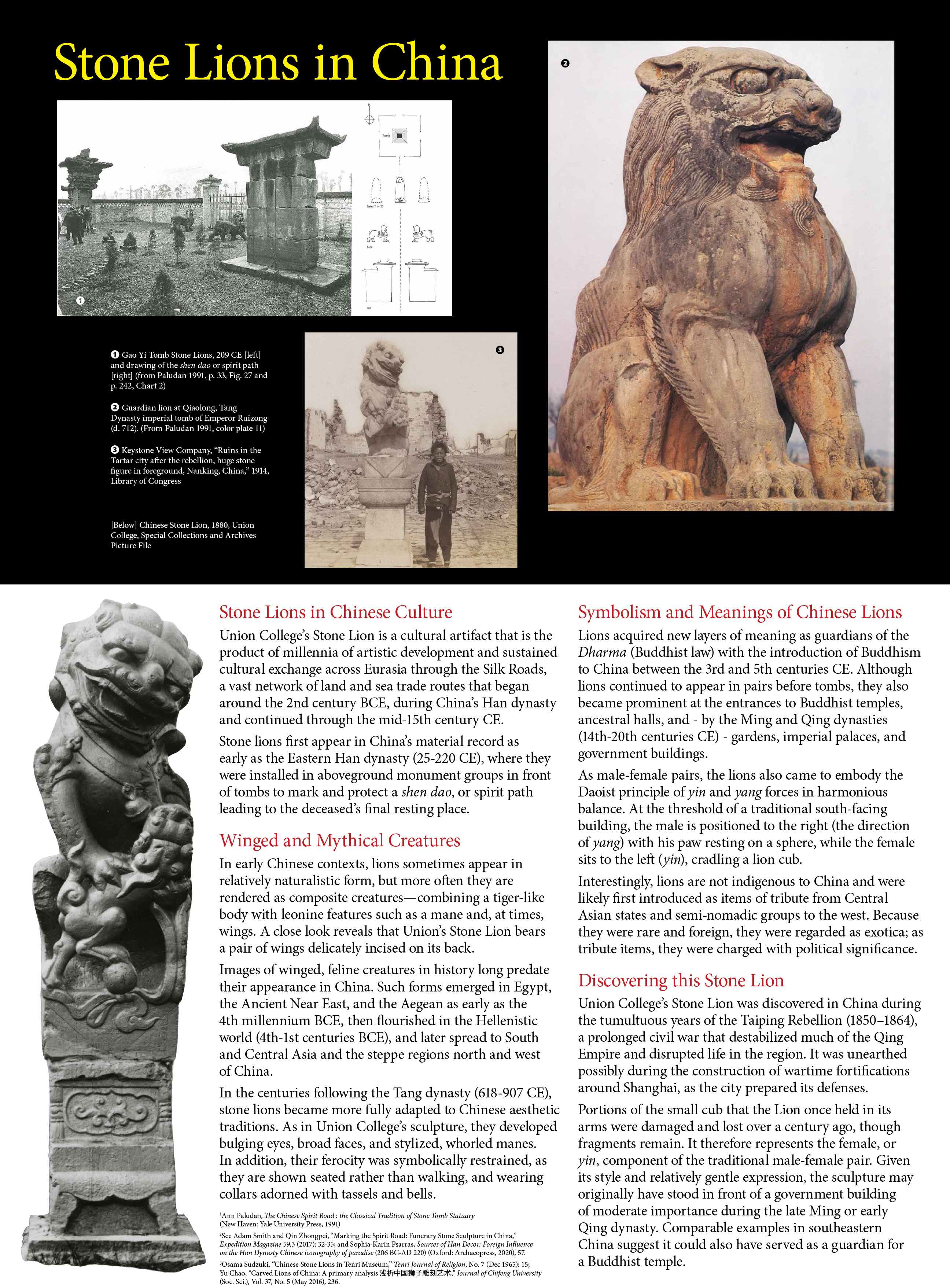
Union College’s Stone Lion is a cultural artifact that is the product of millennia of artistic development and sustained cultural exchange across Eurasia through the Silk Roads, a vast network of land and sea trade routes that began around the 2nd century BCE, during China’s Han Dynasty and continued through the mid-15th century CE.
Stone lions first appear in China’s material record as early as the Eastern Han dynasty (25-220 CE), where they were installed in aboveground monument groups in front of tombs to mark and protect a shen dao, or spirit path leading to the deceased’s final resting place.
Winged and Mythical Creatures
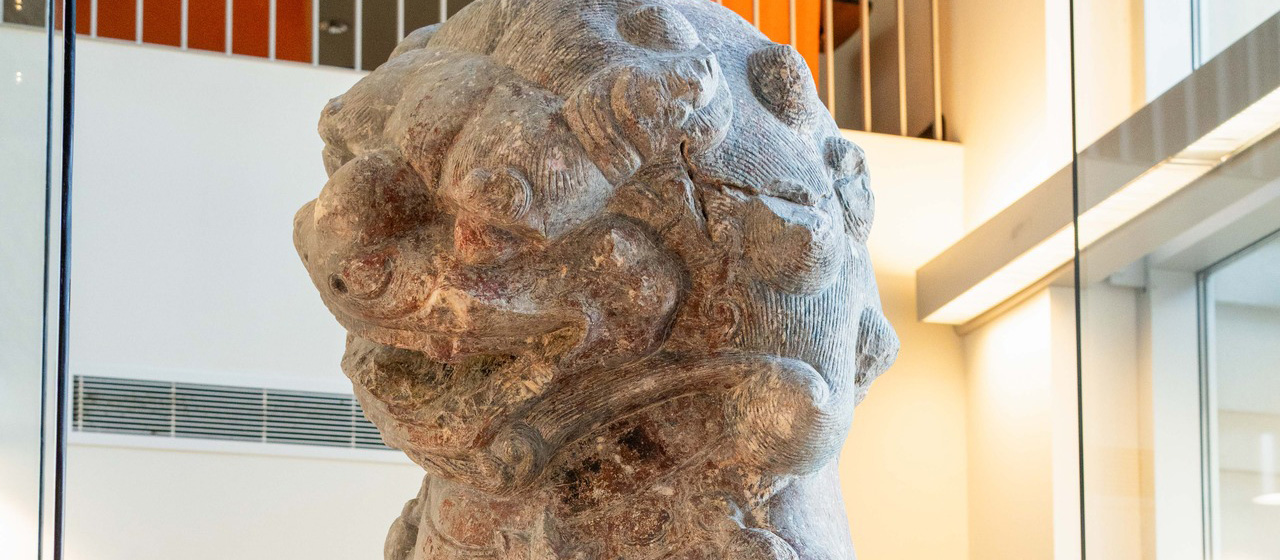
In early Chinese contexts, lions sometimes appear in relatively naturalistic form, but more often they are rendered as composite creatures—combining a tiger-like body with leonine features such as a mane and, at times, wings. A close look reveals that Union’s lion bears a pair of wings delicately incised on its back.
Images of winged feline creatures long predate their appearance in China. Such forms emerged in Egypt, the ancient Near East, and the Aegean as early as the fourth millennium BCE, flourished in the Hellenistic world, and later spread to South and Central Asia and the steppe regions north and west of China. In the centuries following the Tang Dynasty (618-907 CE), stone lions became more fully adapted to Chinese aesthetic traditions. As in Union College’s sculpture, they developed bulging eyes, broad faces, and stylized whorled manes. In addition, their ferocity was symbolically restrained, as they are shown seated rather than walking, and wearing collars adorned with tassels and bells.
Symbolism and Meanings of Chinese Stone Lions
Lions acquired new layers of meaning as guardians of the Dharma (Buddhist law) with the introduction of Buddhism to China between the 3rd and 5th centuries CE. Although lions continued to appear in pairs before tombs, they also became prominent guardians at the entrances to Buddhist temples, ancestral halls, and—by the Ming dynasty and Qing dynasties (14th-20th c CE)—gardens, imperial palaces, and government buildings.
As male-female pairs, the lions also came to embody the Daoist principle of yin and yang. At the threshold of a traditional south-facing building, the male is positioned to the right (the direction of yang) with his paw resting on a sphere, while the female sits to the left (yin), cradling a lion cub.
Interestingly, lions are not indigenous to China and were likely first introduced as items of tribute from Central Asian states and semi-nomadic groups to the west. Because they were rare and foreign, they were regarded as exotica; as tribute items, they were charged with political significance.
Discovering this Stone Lion
Union College’s Stone Lion was discovered during the tumultuous years of the Taiping Rebellion (1850–1864), a prolonged civil war that destabilized much of the Qing Empire and disrupted life in the region. It was unearthed possibly during the construction of wartime fortifications around Shanghai as the city prepared its defenses.
Portions of the small cub Union’s Stone Lion once protected were damaged and lost over a century ago, though fragments remain. It therefore represents the female, or yin, component of the traditional male-female pair. Given its style and relatively gentle expression, the sculpture may originally have stood in front of a government building of moderate importance during the late Ming or early Qing dynasty. Comparable examples in southeastern China suggest it could also have served as a guardian for a Buddhist temple.