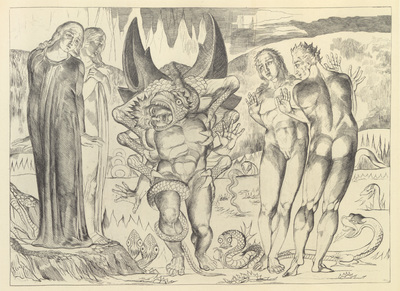
This engraving from Illustrations of Dante (1978 facsimile) is Blake’s depiction of the eighth circle of Hell in the Divine Comedy, which is where thieves go. Agnolo Brunelleschi, the man in the center of the image who is being attacked by the “six footed serpent,” was a thief condemned to be punished in this way for eternity. The cloaked men standing to the left of Brunelleschi are Dante and Virgil, and the men standing to the right of Brunelleschi are his accomplices. This plate is an example of the detailed attention Blake gave to gruesome scenes; the man being attacked is portrayed in agonizing detail, compared to the snakes on the ground.
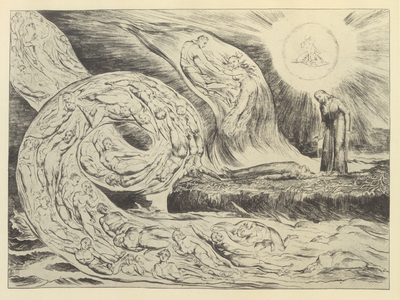
This engraving from Illustrations of Dante (1978 facsimile) is Blake’s representation of a moment during Dante’s progress through the second circle of Hell, or Lust, in the Divine Comedy. His guide, Virgil, shows Dante the souls of those who have sinned through passion and who are forever trapped in a “Whirlwind of Lovers,” as this image is also called. Dante has fainted on the grass out of compassion. Blake took a dynamic approach to visualizing this circle of Hell. It is much more subdued and less gruesome than the late circles of Hell that he depicts.
This illustration from Edward Young’s Night-Thoughts (2005 facsimile) is for Night II (page 36 in the intended publication). The text, a testament to friendship, is surrounded by grapevines. At the bottom of the page, “Philander” and a friend are toasting each other with “the generous blood of Bacchus” (or wine, Bacchus being the Roman god of wine).
This illustration from Edward Young’s Night-Thoughts (2005 facsimile) is for Night V (page 44 in the intended publication). The image is of a man in blue surrounded by numerous books, with a pile in front of him, which he is leaning upon, and a bookshelf behind him. The line Blake is illustrating is marked, “But you are learn’d; in Volumes deep you sit.” An owl, representing learning or wisdom, is perched at the top of the text, and some of the books' authors can be made out: Plato, Aristotle, Cicero, and Plutarch.
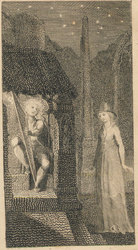
The man to the left is playing a harp in a hut in this image from Wollstonecraft’s Original Stories from Real Life. The woman, Mrs. Mason, is following the sound after an accident to her carriage. In the background are the ruins of a building and a garden. In the accompanying story, which Mrs. Mason tells to her two young charges, she learns that the man has suffered numerous misfortunes at the hand of a tyrant. In compassion and gratitude for the man’s hospitality, Mrs. Mason helps him make a new start in life.
In this image from Wollstonecraft’s Original Stories from Real Life, a man is standing in rigid fear and sorrow as he looks at two dead children. The children are a boy and a girl and lie in a bed in a room that only has one small window. On the right side of the image, there is a dog reaching up to lick the man’s hand. The accompanying text reads: “The Dog strove to attract his attention. He said, Thou will not leave me!”
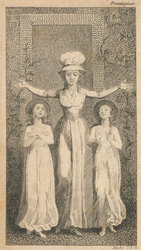
In this image, the frontispiece to Wollstonecraft’s Original Stories from Real Life, the adult woman in the middle is Mrs. Mason and the two children by her side are Mary and Caroline. They appear to be going outside, based upon the flowers and vines that curve in the background. The two girls are literally being led by Mrs. Mason out into the world. The text that accompanies the image is joyful: “Look what a fine morning it is. Insects, Birds, & Animals, are all enjoying existence.” But the girls look up at their guide instead of to nature, in Blake’s beautiful design that nevertheless suggests that they may not be free to enjoy existence fully themselves.
In this illustration for the “Drinking Songs” section of Ritson’s Select Collection of English Songs, a group of six men sit around a table with a bottle and drinks in their hands. The man in the center is raising a toast and the two men on the right embrace with their arms around each other. Images by Blake in this edition were engraved by him on commission, after designs by Thomas Stothard. Not available at the William Blake Archive. Consult the book in Schaffer Library for a detailed view of the image.
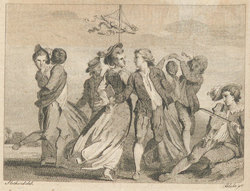
In this lively illustration for Ritson’s Select Collection of English Songs, four couples dance around a Maypole. On the right side of the image is a man playing violin to provide music for the dance. Images by Blake in this edition were engraved by him on commission, after designs by Thomas Stothard. Not available at the William Blake Archive. Consult the book in Schaffer Library for a detailed view of the image.
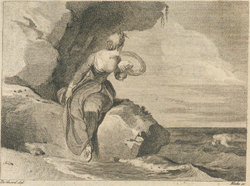
In this illustration of lost love for Ritson’s Select Collection of English Songs, a woman in a dark dress is sitting alone on rocks along the seashore, gazing out to sea. In the ocean to the right side of the image is a corpse floating in the waves, which will likely soon be washed along shore. Images by Blake in this edition were engraved by him on commission, after designs by Thomas Stothard. Not available at the William Blake Archive. Consult the book in Schaffer Library for a detailed view of the image.
In this illustration to the “Pan and Fortune” story in the Fables of John Gay, the half goat / half man Pan is pictured to the left. Pan is playing with dice and cards. To the right is a winged figure standing on a wheel holding a cornucopia, the personification of Fortune. Behind these two main figures are men with axes at work. Blake would have engraved this image, on commission, from a design by someone else. Not available at the William Blake Archive. Consult the book in Schaffer Library for a detailed view of the image.
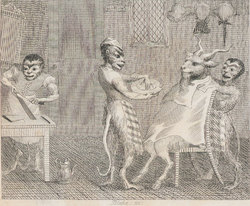
In this illustration to “The Goat without a Beard” story in the Fables of John Gay, we see a barber shop run by monkeys. To the left is a monkey sharpening barber knives for shaving, and in the center is a monkey wearing a checkered apron about to put shaving cream on the goat, sitting in the chair, who is getting prepared for the shave. The monkey behind the goat is tying an apron on the goat to prepare him as well. Blake would have engraved this image, on commission, from a design by someone else. Not available at the William Blake Archive. Consult the book in Schaffer Library for a detailed view of the image.
This side portrait is featured in Lavater’s Essays on Physiognomy. Lavater objects to the design (presumably not by Blake, although he engraved it) in his accompanying text on the grounds that, compared to a frontal portrait, the shape of the nose is incorrect. Precise drawing was essential to Lavater’s study of human psychology through facial characteristics. Not available at the William Blake Archive. Consult the book in Schaffer Library for a detailed view of the image.
In this small decorative piece from Lavater’s Essays on Physiognomy, an arm clothed in a white, loose sleeve is holding a candle. The candle is lit and the light of the candle appears to be attracting four moths that fly dangerously close to the flame. Blake would have received a commission to engrave this image from a design by someone else. Not available at the William Blake Archive. Consult the book in Schaffer Library for a detailed view of the image.
This portrait of Democritus is featured in Lavater’s Essays on Physiognomy. Blake engraved it, on commission, after a portrait by Rubens. As Lavater notes in his accompanying text, the image depicts not the philosopher, but “Democritus the Laugher.” Not available at the William Blake Archive. Consult the book in Schaffer Library for a detailed view of the image.
In this small decorative piece from Lavater’s Essays on Physiognomy, two bearded men are planting and watering trees. The man on the left appears to be placing a tree into the ground and the man on the right is watering one. On the ground there is a rake and shovel and the area on which they are planting trees appears to be partially surrounded by water. Blake would have received a commission to engrave this image from a design by someone else. Not available at the William Blake Archive. Consult the book in Schaffer Library for a detailed view of the image.
In the title page to Visions of the Daughters of Albion (1959 facsimile), a female figure runs through a dark, stormy sea. The waves part where her feet make contact with the water. This suggests that the female figure is Oothoon, the female protagonist of the poem who “over the waves went.” Above Oothoon is a devil-like figure with a human face and fiery wings. This figure’s mouth is agape and eyes sullen and white. Oothoon looks upon this figure in fear. A rainbow penetrates through a thick layer of clouds to the foreground of the illustration. Several human figures perch atop of the letters of the title “Visions of the Daughters of Albion”.
The Application plate from series B of There is No Natural Religion (1971 facsimile) presents an amendment to series A. In the artwork on the plate, a curly haired man wearing a robe appears to be peering over a triangle, measuring the ground. A tree with no leaves frames the message on the plate, using its withered branches as borders: “He who sees the Infinite in all things sees God. He who sees the Ratio only sees himself only.”
The title appears in large font in the center of the title page for series B of There is No Natural Religion (1971 facsimile). It is surrounded by a Gothic arch. There are several human-like figures that seem to be incorporated into the face of the building. Given that the building is most likely a church or cathedral, it is likely that these figures are religious icons.
The frontispiece for series B of There is No Natural Religion (1971 facsimile) features two figures. The one on the left, wearing a robe and long hair, has an arm outstretched over the man on the right, as if in blessing. The man on the right reaches up to the outstretched hand in seeming awe and need. Blake scholars hypothesize that these two figures are intended to represent Jesus and Lazarus. The background echoes the Gothic architecture seen on the title page.
The artwork for the title page of series A of There is No Natural Religion (1971 facsimile) seems to portray the Gothic style of architecture used in churches and tombs in Europe in the Middle Ages. Blake scholars believe this is likely a reference to the type of architecture that Blake was around during days at Westminster Abbey. The title is surrounded by pillars and human figures like those etched into the face of Gothic buildings.
In the frontispiece for series A of There is No Natural Religion (1971 facsimile), two young men with curly hair stand beneath the cover of some trees. One of them is holding a shepherd's crook. Seated in front of them is an elderly couple in long white robes, perhaps in the role of mentors. All of the figures are standing in a shaded grove in the middle of a wheat field. In the background are lush green mountains and a beautiful pink sky.
In this image from The Song of Los (1975 facsimile), Los sits on a cloud with his knees splayed to the side. He clutches his powerful hammer with both hands. Beneath the clouds he sits upon is a glowing red orb. This could be the sun, as Los was thought to have helped create the world, or it could also represent Enitharmon, the female figure Los created from his own blood and tears.
In this image from The Song of Los (1975 facsimile), two miniature figures rest upon white lilies. The figure on the left appears female. She has long blond hair and is wearing a long golden gown that is falling off of one of her shoulders as she rests upon the lily. The figure to the right appears male and has a crown and a scepter, indicating some form of royalty. This figure wears a long rust-colored gown with a blue cape. The sky is dark with stars twinkling brightly enough to illuminate the dew on the blades of grass. Exactly what or whom these figures, and the plate as a whole, are meant to represent within The Song of Los is unclear. The next plate does begin, “The Kings of Asia heard / The howl rise up from Europe! / And each ran out from his Web.” That plate, however, also has its own illustration.