In this image from America, a Prophecy (1963 facsimile), the spirit of revolutionary energy, Orc, is seen naked in a powerful, animal-like pose. Around him are flames, either symbolizing revolution or Hell. The flames take up the majority of the plate, even surrounding some of the words in the poetry.
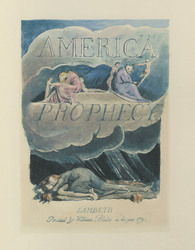
In this image from America, a Prophecy (1963 facsimile), the title of the poem appears in large, billowing clouds whose colors range from light to jet black. Towards the bottom of the images lies a pile of faceless bodies upon which a female figure lays, embracing the topmost body. The top half of the image contains two robed figures sitting upon a layer of clouds, both examining tablets and surrounded by smaller figures. The figure in the pink robe appears to be a young woman with blond hair, while the figure in the blue robe is an elderly man. On the bottom half of the image it is raining or hailing, while sun peaks through the clouds in the top half of the image.
In this image from America, a Prophecy (1963 facsimile), a winged figure sits naked and chained in the darkness of a rocky landscape. This figure is thought to represent either Orc, Blake’s revolutionary figurehead, or Albion’s Angel, a symbol of the establishment forces. Also in this image is an exhausted-looking mother holding her children on her lap. All figures appear to be naked. It is unclear if the mother and child are related to the winged figure. A toppled cannon lies in the bottom left corner of the image.
In this image from All Religions are One (1970 facsimile), an old male figure with a long beard sits on the ground with his legs crossed. Behind him is a winged angel with a hand resting on the shoulder of the man. In the foreground of the picture is a stone tablet that resembles a combination of a tombstone and the Ten Commandments tablet. The tablet reads “All Religions are One."
This image appears near the beginning of Blake’s illustrations to “The Descent of Odin” in Thomas Gray’s Poems (1972 facsimile). It depicts the Norse god literally riding “down the yawning steep” on a horse, with drawn sword, shield out, and armor covering his body. This poem “from the Norse Tongue” was actually translated by Gray from Latin. It is part of a number of Norse legends dealing with the death of Odin’s son, Balder, and Odin’s effort to determine whether Balder’s death can be averted. Here Blake also shows Odin encountering the hideous “Dog of Darkness.” The adjacent page introducing the poem in Blake’s illustrations is startlingly light and whimsical compared to this dark image
This image is from Blake’s illustrations to “A Long Story,” a comic tale of magic and tangled social relationships in Thomas Gray’s Poems (1972 facsimile). A woman lunges away in fear at the sight of a translucent, ghostly figure on the right who bars the entrance to a chapel door. This alarming “sentry” has flames coming out of his eyes, and is “enough to scare ye,” as the next page of the poem attests.
This image is from Blake’s illustrations to “Ode on a Distant Prospect of Eton College,” which is included in Thomas Gray’s Poems (1972 facsimile). The woman wearing a crown appears to be the queen of the “painful family of death” in the line marked with Blake’s X. She has snakes wrapped around her legs and torso and flames at her feet. The tortured figures around her represent the loss and dark times that will inevitably have to be faced by the happy youth at the start of the poem.
This image continues Blake’s illustrations to “The Progress of Poesy,” a long Pindaric ode in Thomas Gray’s Poems (1972 facsimile). It has a cold, ice-mountain setting where a figure walks, covered in a wolf skin and playing a trumpet. From the lines Blake marked with an X, it is clear what is going on: “In climes beyond the solar road, / Where shaggy forms o'er ice-built mountains roam, / The Muse has broke the twilight-gloom / To cheer the shiv'ring native's dull abode.”
This image is from Blake’s illustrations to “The Progress of Poesy,” a long Pindaric ode in Thomas Gray’s Poems (1972 facsimile). It depicts Hyperion in a burst of light emerging from the sun. Hyperion holds a bow and arrow at the ready, as he is about to cast war upon the forces of “sickly” Night and various human ills.
On the title page to Blake’s illustrations to Thomas Gray’s Poems (1972 facsimile), a swan is flying in a deep blue sky. A man is riding on the back of the swan, holding the reigns and reaching for a lyre. He can be interpreted to be “The Pindaric Genius” behind Gray’s work, because a note on the verso of this image refers specifically to the “Genius receiving his Lyre” (symbolically, a sign that he is a poet).
This work by the Trianon Press is a facsimile of a unique copy made by Blake between 1797 and 1798. Its reproduction in three volumes was purchased for Union College by the Friends of the Library.
Although Samuel Palmer’s work had no formal relationship to Blake’s, the Trianon Press elected to publish Palmer’s early sketchbook as a representation of the kinds of artists with whom Blake regularly came into contact. Unlike its Blake facsimiles, for which it tried to make exact copies of original works, Trianon called this a “reproduction” rather than a “facsimile,” because a uniform ink color was used to make the presentation of Palmer’s sketches more readable. Union College holds two copies of this work in different bindings, which were purchased separately by the Friends of the Library and through the library’s annual funds. Not available at the William Blake Archive. Consult the book in Schaffer Library for more information.
This 1874 publication was printed after Blake’s death but from his original copper plates – the last time they were used. They are easily mistaken for an original print from 1825, the date on the title page. The 1874 plates were originally bound together in a single volume, but when the Union College copy was recently conserved, the plates were separated and the glue once used for binding the images together was stabilized on the page.
The 1987 facsimile of Blake’s illustrations of the Book of Job followed the Trianon Press facsimiles that had also been done for the William Blake Trust. This two volume edition not only reproduced the 21 plates and title page that Blake had designed for this work between 1823 and 1826 (with a confusing date of 1825 on the title page), but included related material such as essays, a catalog of states and printings, and commentary on the plates and documentary record by David Bindman. The limited edition of this facsimile was purchased for Union College by the Friends of the Library.
The Trianon Press reproduced the seven engravings that Blake completed for Dante’s Divine Comedy, along with preliminary sketches and other background material, as special project in 1978. The library’s acquisition of this copy in 2016 completed its set of all of the Blake facsimiles produced by the Trianon Press between 1951 and 1987. It was gifted to the library anonymously in honor of James McCord, Union College Professor of English Emeritus.
Blake worked on his designs for this book (composed by Young in the 1740s) between 1795 and 1797. This facsimile edition by the Folio Society, based on the unique copy in the British Museum, was produced in 2005 using digital photography. It was issued with a commentary volume by Robin Hamlyn. This work was purchased for Union College by the Friends of the Library.
This compilation of portraits was a departure for the Trianon Press, which had previously focused on facsimiles of Blake’s illuminated books and designs. But with a text by Blake scholar Geoffrey Keynes, who contributed commentary to the other facsimiles, it continued Trianon’s incomparable record of bringing all aspects of Blake’s work and life to light. This book was purchased for the Union College library by the Friends of the Library. Not available at the William Blake Archive. Consult the book in Schaffer Library for more information.
The title page for The Triumphs of Temper names the artist behind the “new original designs” for the illustrations, Maria Flaxman, as prominently as the poem’s author, William Hayley. Blake’s engravings for these designs caused friction within his circle of friends, but they remain one of the chief interests of this edition. The copy in the Union College library was donated by Hans Rozendaal.
Unlike many of Blake’s other early commissions, for the second edition of this work (which was first published in 1788), he was contracted to submit the designs as well as engrave those selected for the final publication. The six images in the 1791 edition are thus entirely Blake’s. Comparing them to commercial engravings that Blake based on designs by others, it is possible to see very clearly how Blake’s personal style and outlook differed, even when he was doing commercial work. Some of Blake’s designs for Original Stories from Real Life also relate to imagery in his illuminated works, which suggests that he detected rigidity even in the thinking of fellow radicals such as Mary Wollstonecraft. The copy in the Union College library was donated by Hans Rozendaal.
Ritson’s Select Collection of English Songs is divided into three volumes including an introduction, thematic sections, and “airs” or music for the songs. Blake’s engravings for this work were done on commission after designs by Thomas Stothard. The book was published by Joseph Johnson, who was part of a radical circle to which Blake also belonged. Johnson is believed to have published Blake’s first book of poetry, and it was probably he who was responsible for the commission, as he was for many of Blake’s other commissioned work. This book was donated to the library in 1951 by Water C. Baker, Union College Class of 1915. Not available at the William Blake Archive. Consult the book in Schaffer Library for more information.
The Fables were originally published in the 1720s, well before Blake’s lifetime, but they remained popular. Blake, on commission, contributed a number of engravings, based on designs by others, to this 1793 edition. It was donated to the library as part of the Cullen Bequest in 1974. Not available at the William Blake Archive. Consult the book in Schaffer Library for more information.
This study by Geoffrey Keynes, published by the Trianon Press, was intended as a showcase, catalog, and chronology of Blake’s work as well as of the Trianon Press reproductions. It provides commentary and sample plates from Songs of Innocence and of Experience; Visions of the Daughters of Albion; The Marriage of Heaven and Hell; Europe, a Prophecy; America, a Prophecy; The Book of Urizen; Milton; and Jerusalem. Commentary by Keynes, a Blake scholar, was also featured in many of Trianon’s reproductions of individual works by Blake. Union College has a limited edition of this work in the library’s Special Collections, donated by Hans Rozendaal. A commercial edition, published in cooperation with The Orion Press, is also in the library’s collections. Not available in this form at the William Blake Archive; consult the book in the library for more information.
This work has a complex publication history. Songs of Innocence was composed in 1789 and Songs of Experience in 1794, after which the two were often combined, sometimes with an additional, unified title page. The order of poems within the combined publication varies considerably, as does the number of poems selected for it (and for later reproductions). Thus not all of the poems in the series are included in all versions. The coloration also varies from copy to copy.
This particular facsimile of selected poems from Songs of Innocence and of Experience was printed in an edition of 16 copies by Michael Phillips, using a replica of Blake's rolling-press at Oxford University and paper hand-made by W.S. Hodgkinson and Co. around 1927 (the centennial of Blake’s death). The Phillips edition is not colored, but instead is focused on reproducing Blake’s inking and printmaking techniques. Included with the Union College copy are test proofs that Phillips made using various colored inks and strategies; a reproduction of a copper plate used for The Lamb; and other related items. Material like that included in this edition is not available at the William Blake Archive. Consult the book in Schaffer Library for more information. The Union College copy was purchased by the Friends of the Library.
This work has a complex publication history. Songs of Innocence was composed in 1789 and Songs of Experience in 1794, after which the two were often combined, sometimes with an additional, unified title page. The order of poems within the combined publication varies considerably, as does the number of poems selected for it (and for later reproductions). Thus not all of the poems in the series are included in all versions. The coloration also varies from copy to copy.
This particular facsimile of Songs of Innocence and of Experience was produced by Princeton University Press in a series of reproductions of Blake’s illuminated works. It includes transcriptions of the text. It used as its model copy X at King’s College, Cambridge, which, as of early 2018, had not yet been digitized at the William Blake Archive. Copy X is particularly interesting because it was made late in Blake’s career and was still in his possession when he died. Consult the book in Schaffer Library for a detailed view of the material it contains.