The Application plate from series B of There is No Natural Religion (1971 facsimile) presents an amendment to series A. In the artwork on the plate, a curly haired man wearing a robe appears to be peering over a triangle, measuring the ground. A tree with no leaves frames the message on the plate, using its withered branches as borders: “He who sees the Infinite in all things sees God. He who sees the Ratio only sees himself only.”
The title appears in large font in the center of the title page for series B of There is No Natural Religion (1971 facsimile). It is surrounded by a Gothic arch. There are several human-like figures that seem to be incorporated into the face of the building. Given that the building is most likely a church or cathedral, it is likely that these figures are religious icons.
The frontispiece for series B of There is No Natural Religion (1971 facsimile) features two figures. The one on the left, wearing a robe and long hair, has an arm outstretched over the man on the right, as if in blessing. The man on the right reaches up to the outstretched hand in seeming awe and need. Blake scholars hypothesize that these two figures are intended to represent Jesus and Lazarus. The background echoes the Gothic architecture seen on the title page.
The artwork for the title page of series A of There is No Natural Religion (1971 facsimile) seems to portray the Gothic style of architecture used in churches and tombs in Europe in the Middle Ages. Blake scholars believe this is likely a reference to the type of architecture that Blake was around during days at Westminster Abbey. The title is surrounded by pillars and human figures like those etched into the face of Gothic buildings.
In the frontispiece for series A of There is No Natural Religion (1971 facsimile), two young men with curly hair stand beneath the cover of some trees. One of them is holding a shepherd's crook. Seated in front of them is an elderly couple in long white robes, perhaps in the role of mentors. All of the figures are standing in a shaded grove in the middle of a wheat field. In the background are lush green mountains and a beautiful pink sky.
In this image from The Song of Los (1975 facsimile), Los sits on a cloud with his knees splayed to the side. He clutches his powerful hammer with both hands. Beneath the clouds he sits upon is a glowing red orb. This could be the sun, as Los was thought to have helped create the world, or it could also represent Enitharmon, the female figure Los created from his own blood and tears.
In this image from The Song of Los (1975 facsimile), two miniature figures rest upon white lilies. The figure on the left appears female. She has long blond hair and is wearing a long golden gown that is falling off of one of her shoulders as she rests upon the lily. The figure to the right appears male and has a crown and a scepter, indicating some form of royalty. This figure wears a long rust-colored gown with a blue cape. The sky is dark with stars twinkling brightly enough to illuminate the dew on the blades of grass. Exactly what or whom these figures, and the plate as a whole, are meant to represent within The Song of Los is unclear. The next plate does begin, “The Kings of Asia heard / The howl rise up from Europe! / And each ran out from his Web.” That plate, however, also has its own illustration.
In the frontispiece to The Song of Los (1975 facsimile), Urizen, wearing a long white gown, lies among the mountaintops. His eyes face the sky and his arm rests on a skull. Behind him is a range of green mountains. Blake scholars theorize that the skull resting amongst the mountains is a reference to the line “Adam, a mouldering skeleton, lay bleach’d on the garden of Eden.”
In the frontispiece to The Song of Los (1975 facsimile), an elderly male figure with long white hair kneels before an altar. This male figure is likely Urizen, a god-like and oppressive figure in the Blakean universe. He is deep in prayer. Above him in the dark sky is a glowing, multi-colored orb, perhaps a representation of Earth or of counter forces. Beams of light emit from it.
This image from the For the Sexes version of The Gates of Paradise (1968 facsimile) is revised from the For Children version with the addition of an explanation, “Perceptive Organs closed their Objects close.” The harmful effect of “aged ignorance” is illustrated, as in the earlier version, by an image of an elderly male figure sitting at the base of a tree. He wears a long white robe and spectacles, but his eyes are closed. He holds a large pair of scissors, which he is using in an attempt to clip the wings of an angel standing in front of him. The angel’s hands are stretched out, either in sorrow or as protection from the harsh rays of the sun.
The frontispiece for the For the Sexes version of The Gates of Paradise (1968 facsimile) is revised from the For Children version. A child still lies sleeping inside of a tightly wrapped cocoon. The cocoon perches on a single leaf. Above that leaf is another, upon which a caterpillar watches over the resting child. This version, however, has no steaks of rain falling down, in keeping with the addition of Blake’s lines: “The Suns Light when he unfolds it / Depends on the Organ that beholds it.”
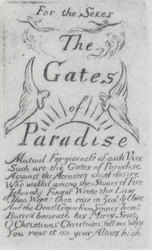
The title page for the For the Sexes version of The Gates of Paradise (1968 facsimile) is substantially revised from the For Children version. A questioning poem now appears below the title. Above the word “Paradise” there is now an outline of a blazing sun. Two winged angels appear to be bowing on either side of the sun. Two human-like figures fly through the air, presumably representing both sexes, and a crowd surrounds them.
In this image from the For Children version of The Gates of Paradise (1968 facsimile), an elderly male figure sits at the base of a tree. He wears a long white robe and spectacles, but his eyes are closed. He holds a large pair of scissors, which he is using in an attempt to clip the wings of an angel standing in front of him. The angel’s hands are stretched out, either in sorrow or as protection from the harsh rays of the sun.
In the frontispiece for the For Children version of The Gates of Paradise (1968 facsimile), a child lies sleeping inside of a tightly wrapped cocoon. The cocoon perches on a single leaf. Above that leaf is another, upon which a caterpillar watches over the resting child. Streaks of black run through the illustration as if to signify that it is raining, but the child is protected.
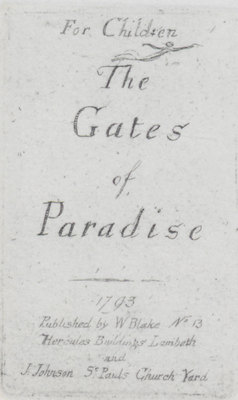
The title page for the For Children version of The Gates of Paradise (1968 facsimile) is very simple. The words of the title, as well as the publishing information, are written in simple font and spread throughout the plate. Beneath the word “children” is a simple human-like figure that appears to be flying through the air.
In this image The Book of Urizen (1958 facsimile), Los appears doubled over, perhaps in pain. His hands are pressed against the side of his head with palms flat, as if he is squeezing his head. His sweat and blood drips all down his body and into a glowing orb in the center of the image. This orb is thought to be the growing Enitharmon, who was the first female figure that emerged from the life blood of Los. In a way, this is a creation image.
In this image from The Book of Urizen (1958 facsimile), a muscular and naked figure, possibly Urizen himself, is diving, falling, or lingering above the earth. His hands are extended in front of him in order to brace himself on two rocks. He is surrounded by dark clouds. This image is part of a series in this work depicting the chaotic strife among the forces that are in conflict with each other.
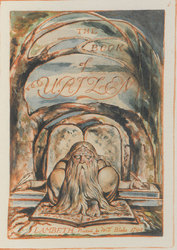
On the title page to The Book of Urizen (1958 facsimile), an elderly male figure, presumably Urizen, sits on top of a large book. Withered trees above him form several arches. Beneath the trees are two stone tablets with no visible writing on them. The overall color scheme of this particular plate is very dark and oppressive, with many of the images colored to seem as if they are rusting and rotting. Urizen’s eyes are closed, but eerily, completely white, so that it seems as if he is making direct, blinded contact with the person viewing the artwork.
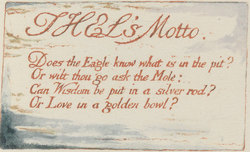
This plate from The Book of Thel appears either at the beginning or the end, depending on which copy is used as a model. In the facsimile by the Trianon Press published in 1965, it appears at the end. Thel’s motto is a representation of her struggle with questions of mortality and meaning in this book. The art on the plate is rather simple. The script is in a copper tone with the name Thel in large capital letters towards the top of the plate. Gentle, pastel-colored strokes of paint surround the poetry and extend towards the corners of the plate.
This image from The Book of Thel (1965 facsimile) is reminiscent of previous lines in the poem, wherein Thel is “like a watry bow ... like shadows in the water.” In the poetry featured on this plate, Thel is speaking to the Worm and the Clod of Clay. Both creatures are attempting to use their experiences in the natural world’s life cycle to comfort Thel about her mortality. They cite a higher purpose that makes their lowly state seem important in the grand scheme of things. The art features Thel facing her own reflection in a still body of water. A radiant sunrise or sunset fills the backdrop and features bright pinks and softer blues. Drooping trees line the bank of the lake. Human figures lay at the feet of Thel, extending their arms towards her.
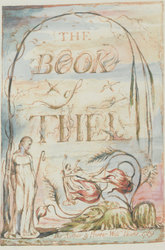
For the title page to The Book of Thel (1965 facsimile), Thel wears a white gown and holds a shepherd's crook while standing at the base of an arched, drooping tree. Nature is everywhere: vines surround the tree, a large body of water stands in the background, several birds fly overhead, and two large red flowers blossom from the ground. Seeming to emerge from one of these flowers is a golden-hued female figure, who is embraced by a floating male figure.
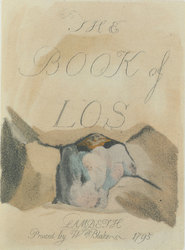
In the title page to The Book of Los (1976 facsimile), a male figure, perhaps Los, is crouching naked in a rocky cave of sorts. He does not face the reader, but rather looks into the darkness of the cave. Blake scholars hypothesize that the positioning of Los in this image indicates that here he is a symbol of fallen humanity.
In this image from The Book of Los (1976 facsimile), we see the “Eno aged mother” that Blake refers to in the opening line of the poem. She is seated beneath “the eternal Oak” with her knees upright and together. Her lips are parted as if she is preparing to sing or speak. Her gown is gray tinged with blue and green, and her hair is long and silver.
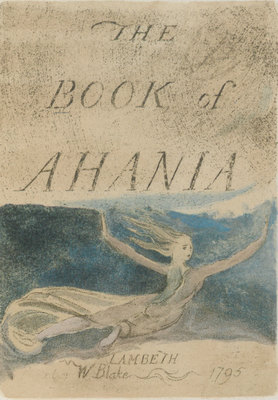
In the title page to The Book of Ahania (1973 facsimile), a female angel floats freely through the sky, arms outstretched, seeming to push back against the forces around her. This gowned figure is likely Ahania, who was thought to “float amongst chaos.” Her golden hair flows behind her. She seems to be flying from the darkness into blue sky.