In this image from Jerusalem, a man opens an arched door that leads to a dark room. Blake scholars theorize that this man is Los, mainly because of the glowing orb he holds in his right hand. The orb casts light and shadows across the doorway as Los steps within. This image from the 1952 facsimile should be compared to the colored facsimiles in the library’s collections from 1951 and 1974. Without full color, some details are lost and the orb seems a much flatter object. The space that Los is moving through also seems more mysterious.
This title page depicts Jerusalem (the female “emanation of the Giant Albion” in the subtitle of the poem) as a butterfly surrounded by figures who are mourning and flying about in distress. Jerusalem is in her unawakened state, separated from Albion. This image from the 1952 facsimile should be compared to the colored facsimile in the library’s collections from 1974. Although the image shows a lot of detail, without color some of the impact is lost.
This image is from the beginning of Blake’s illustrations to “Ode on a Distant Prospect of Eton College,” which is included in Thomas Gray’s Poems (1972 facsimile). It depicts the life of the young scholars at Eton (which Gray himself had attended) as idyllic and inspired. A figure likely representing Henry VI, founder of the college in 1440, floats nearby as a still-revered “holy shade” looking over them. The poem turns much darker as Gray reflects on how life experiences will change these happy youth.
In this image from Jerusalem (1951 facsimile) the figure of the creative spirit Los is shown at his forge, in conflict with opposing energies. The "Spectre" that oppresses him is not, however, necessarily external to him, but part of him. The imagery is one of fire and the poem on the page refers to the “terrible wrath” of Los when confronted with the divisive force of the Spectre. He stamps his feet and throws down his hammer in fury. In the image, however, Los himself appears to be calm and relaxed, perhaps suggesting that he is also “unterrified” by the Spectre, as the next page of the poem reports.
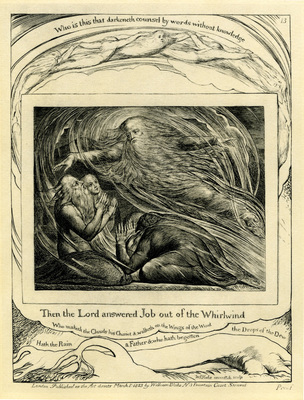
On the left of this image from Blake’s Illustrations of the Book of Job (1987 facsimile), Job and his wife are praying. Job has been begging for answers for his questions, specifically three of them: why was he born, how can he be square with God, and will he live again once he dies. Out of a whirlwind, represented by the radiating circles behind him, God comes to respond to Job’s questions.
Close comparison of this image, from the high-quality 1987 facsimile, with that in the 1874 reprint made using Blake's original plates – both of which are in the library's collections – reveals that facsimiles will always fall somewhat short of the “real thing.” The added accessibility of and research material included with the 1987 facsimile, however, makes it an invaluable resource.
At the top of this image of a detail from Blake’s Illustrations of the Book of Job (1987 facsimile), God is pointing down two of his creations, Behemoth and Leviathan. Behemoth is the creature who appears to have attributes of real animals such as a rhino, elephant and hippo; under him is Leviathan, an underwater sea monster. Both of these are creatures of chaos, who can only be created and destroyed by God himself. The group of people below God, who are looking at the creatures, consists of Job, his wife, and family. Blake surrounds the central illustration with his own selection of texts.
Close comparison of this image, from the high-quality 1987 facsimile, with that in the 1874 reprint made using Blake's original plates – both of which are in the library's collections – reveals that facsimiles will always fall somewhat short of the “real thing.” The added accessibility of and research material included with the 1987 facsimile, however, makes it an invaluable resource.
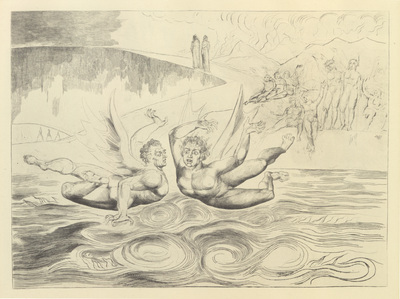
This engraving from Blake's Illustrations of Dante (1978 facsimile) is also a depiction of the eighth circle of Hell in the Divine Comedy. The two devils are flying over boiling seas and are attacking each other because they are unable to find anyone else upon which to bestow their wrath. In the background, to the right of the devils, is a group of other devils on flaming hills; they are watching the fight as if it were a show. Even further in the distance, on a path in the center, are Virgil and Dante, also watching. This image is a good example of the varying degree of detail in Blake’s work on the Divine Comedy. The devils in the center of the image are very detailed, but it is apparent that he didn’t spend much time on this image other than that. The other demons sitting on the hill are mere rushed sketches, and there is only an outline of Virgil and Dante walking the path.
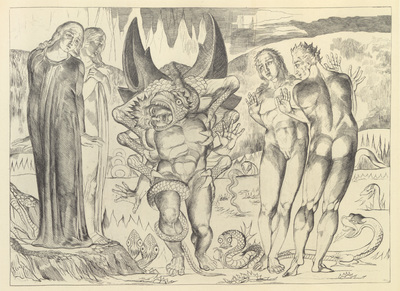
This engraving from Illustrations of Dante (1978 facsimile) is Blake’s depiction of the eighth circle of Hell in the Divine Comedy, which is where thieves go. Agnolo Brunelleschi, the man in the center of the image who is being attacked by the “six footed serpent,” was a thief condemned to be punished in this way for eternity. The cloaked men standing to the left of Brunelleschi are Dante and Virgil, and the men standing to the right of Brunelleschi are his accomplices. This plate is an example of the detailed attention Blake gave to gruesome scenes; the man being attacked is portrayed in agonizing detail, compared to the snakes on the ground.
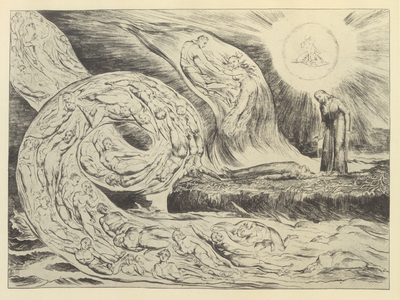
This engraving from Illustrations of Dante (1978 facsimile) is Blake’s representation of a moment during Dante’s progress through the second circle of Hell, or Lust, in the Divine Comedy. His guide, Virgil, shows Dante the souls of those who have sinned through passion and who are forever trapped in a “Whirlwind of Lovers,” as this image is also called. Dante has fainted on the grass out of compassion. Blake took a dynamic approach to visualizing this circle of Hell. It is much more subdued and less gruesome than the late circles of Hell that he depicts.
This illustration from Edward Young’s Night-Thoughts (2005 facsimile) is for Night II (page 36 in the intended publication). The text, a testament to friendship, is surrounded by grapevines. At the bottom of the page, “Philander” and a friend are toasting each other with “the generous blood of Bacchus” (or wine, Bacchus being the Roman god of wine).
This illustration from Edward Young’s Night-Thoughts (2005 facsimile) is for Night V (page 44 in the intended publication). The image is of a man in blue surrounded by numerous books, with a pile in front of him, which he is leaning upon, and a bookshelf behind him. The line Blake is illustrating is marked, “But you are learn’d; in Volumes deep you sit.” An owl, representing learning or wisdom, is perched at the top of the text, and some of the books' authors can be made out: Plato, Aristotle, Cicero, and Plutarch.
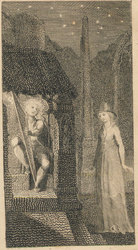
The man to the left is playing a harp in a hut in this image from Wollstonecraft’s Original Stories from Real Life. The woman, Mrs. Mason, is following the sound after an accident to her carriage. In the background are the ruins of a building and a garden. In the accompanying story, which Mrs. Mason tells to her two young charges, she learns that the man has suffered numerous misfortunes at the hand of a tyrant. In compassion and gratitude for the man’s hospitality, Mrs. Mason helps him make a new start in life.
In this image from Wollstonecraft’s Original Stories from Real Life, a man is standing in rigid fear and sorrow as he looks at two dead children. The children are a boy and a girl and lie in a bed in a room that only has one small window. On the right side of the image, there is a dog reaching up to lick the man’s hand. The accompanying text reads: “The Dog strove to attract his attention. He said, Thou will not leave me!”
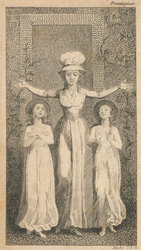
In this image, the frontispiece to Wollstonecraft’s Original Stories from Real Life, the adult woman in the middle is Mrs. Mason and the two children by her side are Mary and Caroline. They appear to be going outside, based upon the flowers and vines that curve in the background. The two girls are literally being led by Mrs. Mason out into the world. The text that accompanies the image is joyful: “Look what a fine morning it is. Insects, Birds, & Animals, are all enjoying existence.” But the girls look up at their guide instead of to nature, in Blake’s beautiful design that nevertheless suggests that they may not be free to enjoy existence fully themselves.
In this illustration for the “Drinking Songs” section of Ritson’s Select Collection of English Songs, a group of six men sit around a table with a bottle and drinks in their hands. The man in the center is raising a toast and the two men on the right embrace with their arms around each other. Images by Blake in this edition were engraved by him on commission, after designs by Thomas Stothard. Not available at the William Blake Archive. Consult the book in Schaffer Library for a detailed view of the image.
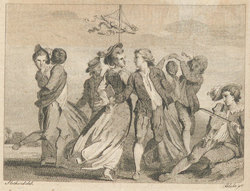
In this lively illustration for Ritson’s Select Collection of English Songs, four couples dance around a Maypole. On the right side of the image is a man playing violin to provide music for the dance. Images by Blake in this edition were engraved by him on commission, after designs by Thomas Stothard. Not available at the William Blake Archive. Consult the book in Schaffer Library for a detailed view of the image.
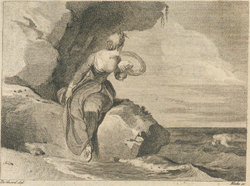
In this illustration of lost love for Ritson’s Select Collection of English Songs, a woman in a dark dress is sitting alone on rocks along the seashore, gazing out to sea. In the ocean to the right side of the image is a corpse floating in the waves, which will likely soon be washed along shore. Images by Blake in this edition were engraved by him on commission, after designs by Thomas Stothard. Not available at the William Blake Archive. Consult the book in Schaffer Library for a detailed view of the image.
In this illustration to the “Pan and Fortune” story in the Fables of John Gay, the half goat / half man Pan is pictured to the left. Pan is playing with dice and cards. To the right is a winged figure standing on a wheel holding a cornucopia, the personification of Fortune. Behind these two main figures are men with axes at work. Blake would have engraved this image, on commission, from a design by someone else. Not available at the William Blake Archive. Consult the book in Schaffer Library for a detailed view of the image.
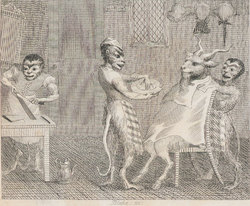
In this illustration to “The Goat without a Beard” story in the Fables of John Gay, we see a barber shop run by monkeys. To the left is a monkey sharpening barber knives for shaving, and in the center is a monkey wearing a checkered apron about to put shaving cream on the goat, sitting in the chair, who is getting prepared for the shave. The monkey behind the goat is tying an apron on the goat to prepare him as well. Blake would have engraved this image, on commission, from a design by someone else. Not available at the William Blake Archive. Consult the book in Schaffer Library for a detailed view of the image.
This side portrait is featured in Lavater’s Essays on Physiognomy. Lavater objects to the design (presumably not by Blake, although he engraved it) in his accompanying text on the grounds that, compared to a frontal portrait, the shape of the nose is incorrect. Precise drawing was essential to Lavater’s study of human psychology through facial characteristics. Not available at the William Blake Archive. Consult the book in Schaffer Library for a detailed view of the image.
In this small decorative piece from Lavater’s Essays on Physiognomy, an arm clothed in a white, loose sleeve is holding a candle. The candle is lit and the light of the candle appears to be attracting four moths that fly dangerously close to the flame. Blake would have received a commission to engrave this image from a design by someone else. Not available at the William Blake Archive. Consult the book in Schaffer Library for a detailed view of the image.
This portrait of Democritus is featured in Lavater’s Essays on Physiognomy. Blake engraved it, on commission, after a portrait by Rubens. As Lavater notes in his accompanying text, the image depicts not the philosopher, but “Democritus the Laugher.” Not available at the William Blake Archive. Consult the book in Schaffer Library for a detailed view of the image.
In this small decorative piece from Lavater’s Essays on Physiognomy, two bearded men are planting and watering trees. The man on the left appears to be placing a tree into the ground and the man on the right is watering one. On the ground there is a rake and shovel and the area on which they are planting trees appears to be partially surrounded by water. Blake would have received a commission to engrave this image from a design by someone else. Not available at the William Blake Archive. Consult the book in Schaffer Library for a detailed view of the image.
In the title page to Visions of the Daughters of Albion (1959 facsimile), a female figure runs through a dark, stormy sea. The waves part where her feet make contact with the water. This suggests that the female figure is Oothoon, the female protagonist of the poem who “over the waves went.” Above Oothoon is a devil-like figure with a human face and fiery wings. This figure’s mouth is agape and eyes sullen and white. Oothoon looks upon this figure in fear. A rainbow penetrates through a thick layer of clouds to the foreground of the illustration. Several human figures perch atop of the letters of the title “Visions of the Daughters of Albion”.