On the combined title page for Songs of Innocence and of Experience (1991 facsimile), two human figures, nude save for branches that act as loincloths, are both positioned horizontally in despairing postures with their faces obstructed from view. The figure on the ground appears to be female, and hovering inches above her is a male figure. Blake scholars theorize that these figures are intended to be Adam and Eve fleeing from the Garden of Eden. They cling to the verdant field beneath them as the sky is streaked with flames. The flames transform into smoke that forms the word “Songs” at the top of the image. Several birds fly throughout the words of the title.
The coloring and impact of this image should be compared to that of other reproductions in the library’s collections, made by different hands or from different original copies. For example, this image, reproduced from a print made late in Blake’s lifetime, appears brighter and more fluid compared to the 1955 version, made from a different copy. This image has more distinct, bright yellows that give the flames more clarity. There is also a border around this plate, unlike in the 1955 version, which has no border. Not available at the William Blake Archive; consult the book in Schaffer Library for a detailed view of the image.
In this image from the “experience” section of Songs of Innocence and of Experience (1983 facsimile), an old man with a long beard and robe walks through the streets of, presumably, London. He is using a crutch, as well as getting assistance from a small boy. The streets are dim and dirty. A beam of light shines down upon the old man and the boy. In the bottom sector of the plate, a man clothed in green warms his hands by a raging fire. The smoke billows up into the top half of the plate.
The coloring and impact of this image should be compared to that of other reproductions in the library’s collections, made by different hands or from different original copies. Compared to the 1955 reproduction, for example, this “London” utilizes more of the open space. The text is wrapped with a border instead of filled in with color. The scene at the top is also less colorful than the 1955 version; there is also less emphasis on the beam of light. These differences reflect differences in the original copies by Blake that were used as models for each of the two facsimiles.
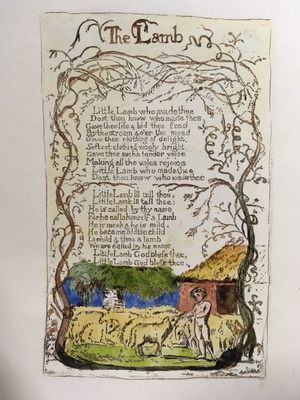
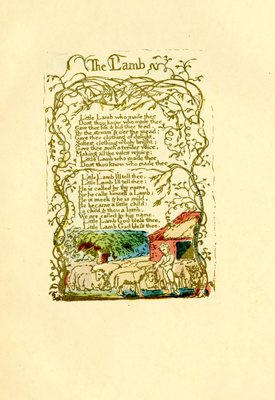
A child feeds a small lamb from the palm of his hand in the foreground of this image from Songs of Innocence included in the combined edition with Songs of Experience (1983 facsimile). The two are framed by vines that border the illustration on this plate. Behind them is a field filled with grazing sheep. To the right of the herd is a cottage with a thatched straw roof. Vines surround the bulk of the text on this page, except for the title which appears above the vines in a larger font.
The coloring and impact of this image should be compared to that of other reproductions in the library’s collections, made by different hands or from different original copies. This uncolored proof in black ink from the Manchester Workshop, for example, allows us to appreciate details that are harder to see when the ink color is more muted or when watercolors are added later. This print also shows what the effect would be if the borders of the copper printing plate were also inked (or not wiped free of ink) before being pressed onto the paper. Not available at the William Blake Archive; consult the book in Schaffer Library for a detailed view of the image.
A child feeds a small lamb from the palm of his hand in the foreground of this image from Songs of Innocence (1983 facsimile). The two are framed by thick vines that border the illustration on this plate. Behind them is a field filled with grazing sheep. To the right of the herd is a cottage with a thatched straw roof. Trees give the cottage shade from the sun. Vines surround the bulk of the text on this page, except for the title which appears above the vines in a larger font.
The coloring and impact of this image should be compared to that of other reproductions in the library’s collections, made by different hands or from different original copies. This image of The Lamb, for example, almost gives the impression of a rainbow. Each of the colors seamlessly blends together creating a colorful and thick border around the text. The text is printed in a brown ink that blends in with the trees and lambs.
This version of the title page for Songs of Experience, included in the combined edition of Songs of Innocence and of Experience (1983 facsimile), is a simple impression of the title with a few leaves above it, without the rest of the images or colors found in copies made by Blake. The Manchester Workshop edition used specially created paper for their project, which is effective in showing the deep impression left by an uninked plate. This paper, however, is generally thought to be thicker than paper that would have been used by Blake. Not available at the William Blake Archive; consult the book in Schaffer Library for a detailed view of the image.
In the title page for Songs of Experience, included in the combined edition of Songs of Innocence and of Experience (1983 facsimile), an elderly couple appears to have died recently. They lie side by side in a bed with their arms stretched out flat at their sides. At the foot of the bed, on either side, is a woman in a blue or green dress. Both women appear to be distressed and have their hands in front of them in grief or prayer. The words that comprise the title are surrounded by delicate pink flowers, as well as two figures with legs extended in a sort of dance pose. The picture beautifully juxtaposes joy and agony - surely two key components of ‘experience’.
The coloring and impact of this image should be compared to that of other reproductions in the library’s collections, made by different hands or from different original copies. This image has more brown and green hues compared to the 1955 reproduction, for example. It also utilizes more of the white space around the title, lacking some of the color of the 1955 copy. These differences reflect differences in the original copies by Blake that were used as models for each of the two facsimiles. The muted colors of the 1983 reproduction also show off the homemade paper created for this project.
A male figure takes up the foreground in the frontispiece to Songs of Innocence, included in the combined edition of Songs of Innocence and of Experience (1955 facsimile). He is holding a wooden musical instrument that looks to be some type of flute. He stares at a cherubic figure that is flying above him. Two tall, lush trees frame the illustration on this plate. Behind the male figure are acres of crops or pasture land with grazing sheep. The whole effect is one of sweet, pastoral inspiration.
The coloring and impact of this image should be compared to that of other reproductions in the library’s collections, made by different hands or from different original copies.
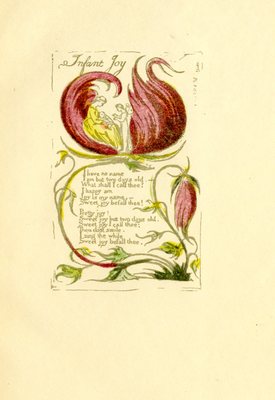
Two flowers bloom from a patch of grass in the bottom right corner of this plate from Songs of Innocence (1927 facsimile). One flower is still drooping and not fully formed. The other is a magnificent fuchsia and has opened its petals. Between the petals sits a young woman wearing a long yellow gown and holding a newborn child. A female figure with wings wearing a white gown stands across from the woman with arms extended, as if she is waiting to hold the child. The words “Infant Joy” are in light cursive writing at the top of the plate, with the rest of the poem nestled in between the stems of the flowers. The image reflects the “sweet joy” of the poem.
The coloring and impact of this image should be compared to that of other reproductions in the library’s collections, made by different hands or from different original copies. Like other images in the 1927 facsimile, for example, this copy of Infant Joy is colored in much darker, richer tones than in the 1954 facsimile. Its flowers and stems are accented with the deepest shades of color, which might normally imply that they are towards the end of their life span. According to the poem, however, this is an occasion of “infant joy.”
A child feeds a small lamb from the palm of his hand in the foreground of this image from Songs of Innocence (1927 facsimile). The two are framed by thick brownish vines that border the illustration on this plate. Behind them is a field filled with grazing sheep. To the right of the herd is a cottage with a thatched straw roof. Trees give the cottage shade from the sun. Vines surround the bulk of the text on this page, except for the title which appears above the vines in a larger font.
The coloring and impact of this image should be compared to that of other reproductions in the library’s collections, made by different hands or from different original copies. This image of The Lamb, for example, has a heavier feel than the 1954 facsimile. The contrast between the text in brown and the dark and deeply colored scene on the bottom makes the image feel like it is bottom heavy. This version of The Lamb also appears to have been done with more control, instead of letting the colors flow into one another. Like the 1926 facsimile, based on the same model by Blake, it also lacks the wash of color behind the cottage that can be seen in the 1954 reproduction, representing the sky or a mountain.
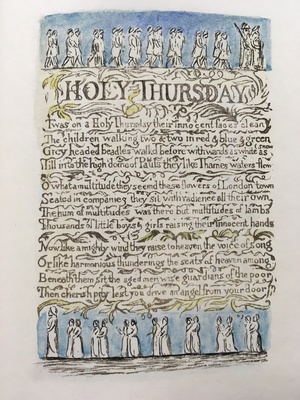
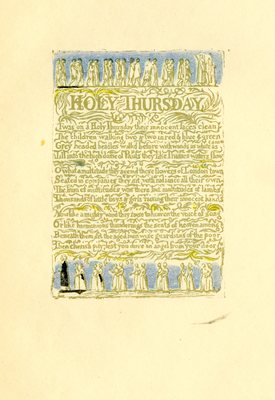
In this illustration from Songs of Innocence (1927 facsimile), there are small scenes at the top and bottom of the plate. The top scene shows a line of uniformed boys walking two by two behind two older men wearing long coats, hats, and carrying some form of stick. In the bottom scene, girls walk two by two in the opposite direction as the boys. Leading them is a woman in a very plain dress who appears to be carrying a basket. Between these two orderly scenes is the text of the poem, throughout which small vines are drawn. The title, “Holy Thursday,” is also surrounded by vines beneath the topmost scene.
The coloring and impact of this image should be compared to that of other reproductions in the library’s collections, made by different hands or from different original copies. This image is very similar to the 1926 reproduction of Holy Thursday, modeled on the same copy by Blake, and emphasizing soft blues and greens in contrast to the text. However, it uses less black for the figures, leaving the black ink of the text to stand out even more. It also is very different from the 1954 version. It appears more divided into three sections, whereas in the 1954 version, which is primarily colored in similar tones, the images and text blend together more seamlessly.
A male figure takes up the foreground in this image from Songs of Innocence (1927 facsimile). He is holding a wooden musical instrument that looks to be some type of flute. He stares at a cherubic figure that is flying above him. Two tall, lush trees frame the illustration on this plate. Behind the male figure are acres of crops or pasture land with grazing sheep. The whole effect is one of sweet, pastoral inspiration.
The coloring and impact of this frontispiece should be compared to that of other reproductions in the library’s collections, made by different hands or from different original copies. The image here is much darker than the 1954 reproduction of this frontispiece, for example. This image has a dark blue sky and dark green grass and trees that lead into black shadows, casting an overall nighttime feel to the image. The main figure is also colored entirely differently.
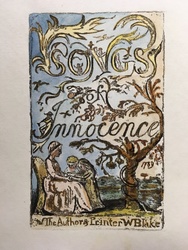
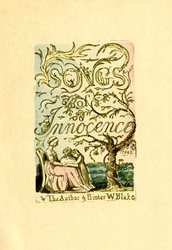
On the title page of Songs of Innocence (1927 facsimile), a mother, clad in a long pink gown and a white bonnet, sits upright in a chair while children kneel by her feet. In her lap is a large book in which the children appear to be engrossed. Behind the scene of the mother and children reading together is a deep blue colored lake. In the foreground of the illustration is a tree trunk that appears old and rotten, but has a large fertile branch extending from it. The branch splits into several parts that form the title, Songs of Innocence. Small human figures and birds perch on the various letters that make up the word Songs.
The coloring and impact of this image should be compared to that of other reproductions in the library’s collections, made by different hands or from different original copies. A particularly strong comparison can be made to the 1926 facsimile title page, even though both were generally based on the same copy by Blake. The 1926 reproduction is bright and soft, whereas the 1927 title page is much richer and also darker. The dark blue sky almost makes it feel like a storm is coming, and the dark brown tree feels more eerie. It makes a stronger impression of the Songs of Experience to come.
Two flowers bloom from a patch of grass in the bottom right corner of this plate from Songs of Innocence (1926 facsimile). One flower is still drooping and not fully formed. The other is a magnificent fuchsia and has opened its petals. Between the petals sits a young woman wearing a long yellow gown and holding a newborn child. A female figure with wings wearing a white gown stands across from the woman with arms extended, as if she is waiting to hold the child. The words “Infant Joy” are in light cursive writing at the top of the plate, with the rest of the poem nestled in between the stems of the flowers. The image reflects the “sweet joy” of the poem.
The coloring and impact of this image should be compared to that of other reproductions in the library’s collections, made by different hands or from different original copies. Unlike the 1954 reproduction, for example, the female figure with wings blends into the image because she is not colored in blue. This shifts the emphasis from a three person interaction to the woman holding the newborn and the flower in which she is sitting.
A child feeds a small lamb from the palm of his hand in the foreground of this image from Songs of Innocence (1926 facsimile). The two are framed by thick green vines that border the illustration on this plate. Behind them is a field filled with grazing sheep. To the right of the herd is a cottage with a thatched straw roof. Trees give the cottage shade from the sun. Vines surround the bulk of the text on this page, except for the title which appears above the vines in a larger font.
The coloring and impact of this image should be compared to that of other reproductions in the library’s collections, made by different hands or from different original copies. This image of The Lamb, for example, has much brighter colors compared to the 1954 facsimile, drawing the eye to the illustration more strongly. It also lacks the wash of color behind the cottage that can be seen in the 1954 reproduction, representing the sky or a mountain.
In this illustration from Songs of Innocence (1926 facsimile), there are small scenes at the top and bottom of the plate. The top scene shows a line of uniformed boys walking two by two behind two older men wearing long coats, hats, and carrying some form of stick. In the bottom scene, girls walk two by two in the opposite direction as the boys. Leading them is a woman in a very plain dress who appears to be carrying a basket. Between these two orderly scenes is the text of the poem, throughout which small vines are drawn. The title, “Holy Thursday,” is also surrounded by vines beneath the topmost scene.
The coloring and impact of this image should be compared to that of other reproductions in the library’s collections, made by different hands or from different original copies. This copy, for example, puts more emphasis on the leading figure in the bottom scene by making the figure be in black clothing, and the two figures behind have black accents. Compared to the 1954 facsile that has an overall brown hue, this image has a lighter feeling, with the green and blue colors being used. These color choices could possibly be intended to relate back to the title page by representing the sky and trees.
On the title page of Songs of Innocence (1926 facsimile), a mother, clad in a long pink gown and a white bonnet, sits upright in a chair while children kneel by her feet. In her lap is a large book in which the children appear to be engrossed. Behind the scene of the mother and children reading together is a deep blue colored lake. In the foreground of the illustration is a tree trunk that appears old and rotten, but has a large fertile branch extending from it. The branch splits into several parts that form the title, Songs of Innocence. Small human figures and birds perch on the various letters that make up the word Songs. The effect is calm, peaceful, and full of promise.
The coloring and impact of this image should be compared to that of other reproductions in the library’s collections, made by different hands or from different original copies. Compared to the 1954 version, for example, this title page has a much more pastel overtone.
This image from the 1974 facsimile of Jerusalem is on the verso of a trial proof for the lower portion of Plate 41 of Jerusalem, which begins “Bath who is Legions . . “ The image on the verso here is of a portion of the frontispiece to Blake’s Europe, a Prophecy. The image from Europe was clearly on a waste proof (one Blake never intended to use), so he tested an image from Jerusalem on the other side. This material from the 1974 facsimile of Jerusalem is an interesting demonstration of Blake’s working methods. Blake, who always struggled financially, reused precious materials and paper when he could.
Note: As of early 2018, none of the material used for this facsimile had been digitized at the William Blake Archive. Consult the book in Schaffer Library for a detailed view of this particular image.
This image from Jerusalem (1974 facsimile) is a trial proof for the lower portion of Plate 41 of Jerusalem, which begins “Bath who is Legions . . .” It was included in this facsimile, in part, as a demonstration of Blake’s working methods. He printed it on the verso of a waste proof of a portion of the frontispiece to his Europe, a Prophecy. The image here depicts a huddled figure next to a scroll which reads, in reverse, “Each Man is in his Spectre’s power . . .”
Note: As of early 2018, none of the material used for this facsimile had been digitized at the William Blake Archive. Consult the book in Schaffer Library for a detailed view of this particular image.
In this image from Jerusalem, a man opens an arched door that leads to a dark room. Blake scholars theorize that this man is Los, mainly because of the glowing orb he holds in his right hand. The orb casts light and shadows across the doorway as Los steps within. This image from the 1974 facsimile should be compared to the colored facsimile in the library’s collections from 1951. Like the title page of the 1974 edition, the colors are more limited in range to yellows and gold, but the effect of light entering a darkened space is just as effective.
Note: As of early 2018, none of the material used for this facsimile had been digitized at the William Blake Archive. Consult the book in Schaffer Library for a detailed view of this particular image.
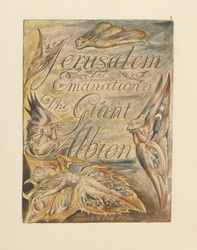
This title page from Jerusalem (1974 facsimile) depicts Jerusalem (the female “emanation of the Giant Albion” in the subtitle of the poem) as a butterfly surrounded by figures who are mourning and flying about in distress. Jerusalem is in her unawakened state, separated from Albion. This image from the 1974 facsimile should be compared to the colored facsimile in the library’s collections from 1951. The comparison shows how different Blake’s use of color could be from copy to copy. Here it is more subtle and uses shades of yellow and gold instead of a full rainbow to suggest Jerusalem’s potential.
Note: As of early 2018, none of the material used for this facsimile had been digitized at the William Blake Archive. Consult the book in Schaffer Library for a detailed view of this particular image.
The Trianon Press produced four different versions of Jerusalem. Blake only completed one full colored copy of the work, which never sold. A few uncolored versions, or tinted only in black and gray, also exist. This facsimile is of an incomplete set of colored prints for the poem (copy B) and includes four watercolor proofs for images that Blake printed on the verso of waste proofs from his Europe, a Prophecy. These trial proofs for Jerusalem show Blake’s re-use of precious paper. The facsimile at Union College was purchased by the Friends of the Library in 1974. Union also holds two copies of an introduction to and commentary on Jerusalem, written by Joseph Wicksteed, and published by the Trianon Press in 1953. These copies were donated to the library by Hans Rozendaal and Walter Tower.
Note: As of early 2018, none of the material used for this facsimile had been digitized at the William Blake Archive. Consult the book in Schaffer Library for more information.
The Trianon Press produced four different versions of Jerusalem. Blake only completed one colored copy of the work, which never sold. A few uncolored versions, or tinted only in black and gray, also exist. This facsimile is of uncolored version copy C, but it also includes a transcription of each plate. It was donated to the library by Walter Tower. Union also holds two copies of an introduction to and commentary on Jerusalem, written by Joseph Wicksteed, and published by the Trianon Press in 1953. These copies were donated to the library by Hans Rozendaal and Walter Tower.
Although the images in Blake’s plates do not always seem to relate very clearly to the text, in this case from Jerusalem the male figure at the bottom would seem to represent Albion, calling to his female counterpart Jerusalem in the lines of the poem at the top of the page: “Awake! Awake Jerusalem! O lovely Emanation of Albion / Awake and overspread all Nations as in Ancient Time / For lo: The Night of Death is past and the Eternal Day / Appears upon our Hills! Awake Jerusalem, and come away. / So spake the Vision of Albion . . .” This image from the 1952 facsimile should be compared to the colored facsimile in the library’s collections from 1951. Without full color, the brilliance of the sun is less effective and the distinction between day and night is much less clear.
This plate from Jerusalem appears at "The End of the Song of Jerusalem.” The emphasis is on the central image of two figures, male and female, who are embracing. Their arched posture creates the appearance that they are in a whirlwind of fire. The female figure’s hair disappears into the fire, while the male is protected by his halo from the fire touching him at all. Yet the overwhelming message is of unity as the poem identifies “All Human Forms” as one in “the Life of Immortality.” This image from the 1952 facsimile should be compared to the colored facsimile in the library’s collections from 1951. Without full color, some of the drama of the image is lost, but overall the message may be even more powerful in its simple unity of color.